
The hidden cost of tool sprawl in service businesses
Disconnected CRM, project, and invoicing tools quietly drain hours and cash. Learn to estimate your weekly ops drag and reduce it without a rip-and-replace.
Tool sprawl: the invisible “tax” on service-operations

Service businesses rarely choose tool sprawl on purpose. It happens one “quick fix” at a time: a crm for leads, a separate project board for delivery, a time tracker, an invoicing app, and a spreadsheet to reconcile it all. Each tool looks reasonable in isolation—especially for an smb team moving fast—but the seams between them become your real operating system.
The costs often stay hidden because they show up as small delays and micro-errors: re-entering contact data, copying deal notes into kickoff docs, hunting down SOW versions, or asking “is this invoice sent yet?” in Slack. These aren’t dramatic failures; they’re constant friction.
Over time, this friction becomes a compounding drag on service-operations: missed handoffs, unclear ownership, and a growing gap between “what’s happening” and “what the dashboards say.” If you’re trying to scale delivery quality while keeping margins intact, reducing that gap is where workflow-automation and modern erp thinking start to matter—even before you feel “big enough” for an ERP.
Where the money goes: rework, delayed handoffs, revenue leakage, and decision latency
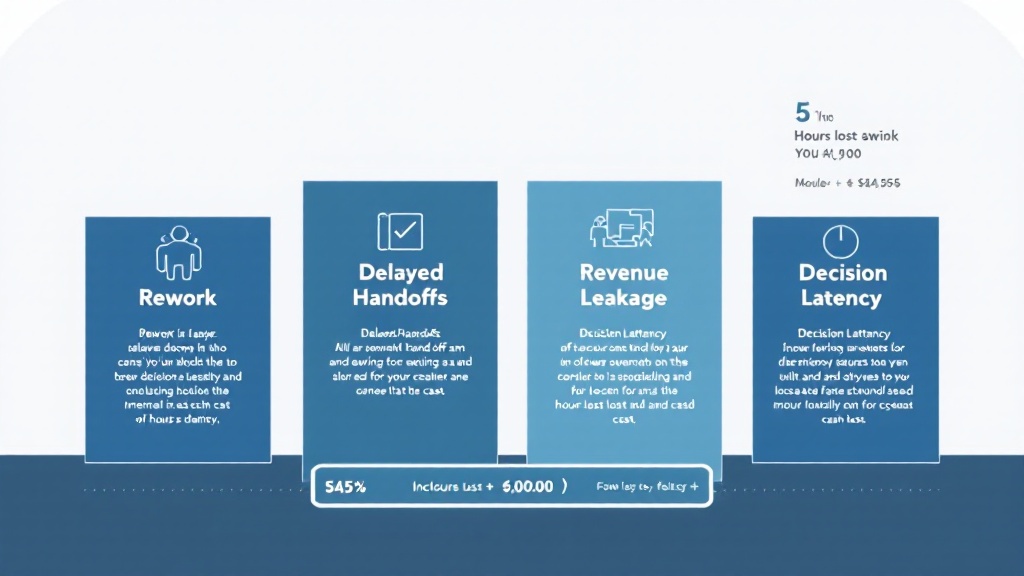
Tool sprawl creates four common “invisible taxes.” Rework is the obvious one: duplicate entry and fixing mismatched fields (company names, line items, payment status). Delayed handoffs happen when a deal closes but delivery doesn’t get clean context—so kickoff slips, tasks start late, and clients feel uncertainty. Revenue leakage follows: unbilled change requests, forgotten retainers, late invoices, and slow collections when project status and billing status drift apart. Finally, decision latency: leaders can’t trust pipeline-to-capacity-to-cash reporting, so they overstaff, underprice, or hesitate on hiring.
A simple way to estimate weekly “ops drag” is:
- Hours lost/week = (people × minutes/day lost × workdays) ÷ 60
- Cash cost/week = hours lost/week × fully loaded hourly rate
Example: 12 people × 18 min/day × 5 days = 18 hours/week. At $85/hr loaded, that’s $1,530/week—before counting late invoicing or churn risk. This is why crm + delivery + finance fragmentation becomes an erp problem long before you call it one.
How to reduce ops drag without a rip-and-replace overhaul

You don’t need to replace everything at once. The lowest-risk path is to reduce the seams: start by defining a unified data model—what counts as a customer, deal, project/task set, and invoice—and decide which system is the source of truth for each. Then standardize the handoffs with workflow-automation: when a deal moves to “Won,” create a delivery plan; when tasks hit “Done,” trigger invoice drafting; when invoices age, trigger reminders and internal alerts.
Next, use templates to make consistency the default. A template-first approach (pipeline → delivery → invoicing) helps an smb team avoid reinventing workflows per client while still allowing exceptions. Add embedded AI where it actually saves time: summarize call notes into next steps, draft follow-ups, and generate task lists—with admin controls and audit trails so teams can trust the output.
Platforms like LeadtoCash Hub are built for this middle ground: unify crm, lightweight project ops, invoicing, and reporting while syncing with Google/Microsoft email and calendars, QuickBooks/Xero, Stripe, and file storage. The goal isn’t “more software”—it’s fewer handoffs, faster decisions, and service-operations you can scale.